Beyond the Build: How Agencies Can Win the Next Era of High-Converting Websites

As the industry gathers around events like Web Summit, one thing is becoming clear: the way agencies build websites is changing faster than most operating models can keep up with.

What used to be a linear, labor-intensive process is now being redefined by intelligent systems that change timelines, reduce manual work, and more importantly — reshape how performance is achieved.

This isn’t about working faster for the sake of efficiency. It’s about rethinking how agencies create value.

The Old Model Is Breaking Down

For years, agencies have operated within a familiar framework: discovery, wireframes, design, development, revisions, launch, and then optimization. It’s a process built on expertise, but also on time.

The challenge? Clients no longer measure value in hours spent. They measure it in outcomes delivered, and how quickly those outcomes arrive.

When a website takes weeks (or months) to go live, the opportunity cost is real. Campaigns are delayed. Revenue is postponed. Competitive advantage shrinks.

Agencies that continue to rely purely on manual workflows are starting to feel that pressure.

Speed Changes the Conversation

AI-powered website creation is often framed as a productivity upgrade. In reality, it’s much more than that.

When you can go from zero to a fully structured website in minutes with Brizy AI, the conversation with clients shifts. Instead of discussing timelines and deliverables, you’re discussing strategy, positioning, and growth.

Speed becomes a strategic lever:

  • Faster launches mean faster validation of ideas
  • Faster iterations mean better performance over time
  • Faster delivery means higher client satisfaction

But speed alone isn’t enough. What matters is what you’re speeding up.

Leadership Perspective: What This Shift Really Means

From a product and agency standpoint, this shift is not just about faster delivery — it’s about redefining what “building websites” actually means.

“We’re moving away from the idea that a website is something you ‘finish.’ Instead, it becomes something you continuously generate, refine, and align with business goals in real time. This is why we’ve created Brizy AI not only for cloud-hosted websites, but also WordPress,” adds Brizy CEO, Dimi Baitanciuc.

For agencies, this changes internal structure as much as external delivery. Teams are no longer just producing work — they are orchestrating systems that produce outcomes.

“The real shift is that agencies stop being production units and start becoming growth infrastructure for their clients,” he concludes.

From Blank Canvas to Block-Based AI Creation

One of the biggest inefficiencies in traditional web design is starting from a blank canvas — even when the business itself is already well defined.

With Brizy AI, agencies can now generate websites using real business inputs such as Google Business profiles, Facebook pages, or Instagram pages, instantly turning existing information into structured, usable websites.

But the real shift happens after generation. Brizy AI website builder is built around a block-based system, where every part of the website is flexible and editable. Agencies can:

  • regenerate entire sections with one click
  • replace text or images individually or across a full block
  • undo, redo, or fully regenerate sections
  • adjust fonts and colors dynamically
  • remove or rebuild sections that don’t fit the strategy

This turns website creation into an iterative process rather than a fixed build.

Instead of being locked into predefined templates, agencies can continuously refine structure and content as the project evolves.

With Brizy AI 1.5, the system also moves beyond standard page limitations. Agencies are no longer restricted to fixed page types like homepage, about, or services. They can now:

  • generate fully custom pages with specific naming and goals
  • let AI suggest page types based on industry context
  • add new pages during the AI generation process itself
  • insert new blocks anywhere on the page using structured categories like Hero, Features, Forms, or Carousel

Entire sections can also be replaced or removed instantly, allowing the website to evolve in real time instead of being locked into an early structure.

The result is a shift from static website building to adaptive website generation — where structure, content, and design continuously align with business needs.

Moving From Reactive to Predictive Performance

Conversion optimization has traditionally been reactive. You launch a site, gather data, and then start improving it through testing.

That model still works, but it’s slow.

What’s emerging now is a predictive approach. By learning from patterns across thousands of websites and user interactions, AI can suggest (or generate) structures that are aligned with conversion goals from day one.

For agencies, this changes the workflow:

  • Fewer cycles spent on basic optimization
  • More confidence in initial launches
  • More time allocated to high-impact improvements

It doesn’t eliminate testing—but it significantly shortens the path to performance.

UX Is No Longer Just Design—It’s Revenue

Agencies have always known that user experience matters. What’s changed is how directly it ties to business outcomes.

Users form opinions about a website almost instantly. If the experience feels confusing, slow, or cluttered, they leave. And when they leave, conversions disappear with them.

This is where intelligent systems bring a real advantage. They don’t just generate pages, but structure experiences:

  • Clear navigation that reduces friction
  • Content flow that guides decisions
  • Layouts that prioritize action over decoration

For agencies, this means delivering websites that don’t just look good in a presentation, but perform in the real world.

Personalization Is Becoming the New Standard

Looking ahead, one of the most important shifts agencies need to prepare for is personalization at scale.

Static websites are giving way to adaptive experiences: sites that adjust based on user behavior, intent, and context.

This opens up new possibilities:

  • Different messaging for different audience segments
  • Dynamic content that reflects user needs
  • Conversion paths that evolve in real time

For agencies, personalization isn’t just a feature, it’s an opportunity to offer more strategic value and deeper client impact.

The Business Model Shift Agencies Can’t Ignore

Perhaps the most important implication of all is how this transformation affects agency business models.

When execution becomes faster and more automated, the real value moves upstream:

  • Strategy over production
  • Systems over one-off projects
  • Recurring value over single deliverables

Agencies that embrace this shift can start to productize their services, offering website creation as a scalable solution rather than a custom-built process every time.

This doesn’t replace creativity. It amplifies it by removing repetitive work, teams gain more space to think, test, and innovate.

A New Role for Agencies

The agencies that will stand out in the next 12–24 months won’t be the ones that simply adopt new tools. They’ll be the ones that rethink their role entirely.

From builders to orchestrators.
From executors to strategic partners.
From service providers to growth enablers.

The Takeaway

High-converting websites are no longer defined by how much time goes into building them. They’re defined by how effectively they guide users, communicate value, and drive action.

The tools have changed. The expectations have changed. And the agencies that adapt fastest will be the ones that lead.

This isn’t about replacing what agencies do best.

It’s about removing everything that slows them down, and doubling down on what actually moves the needle.

This is the direction tools like Brizy AI are moving toward — where agencies don’t just build websites, they deploy systems that generate them.

Why Agencies Lack Visibility Into Client Sites And How to Fix It

When something breaks on your client’s site, the first question you ask is “How did this happen?” More often than not, this question goes unanswered. This is the visibility gap, and it’s one of the most common operational frustrations for agencies managing WordPress sites at scale.

The Visibility Gap: What It Is and Why It Exists

There are plenty of ways to get visibility into your WordPress sites, from plugins and uptime monitoring to managed hosting panels. However, this data is often too limited or fragmented to support effective troubleshooting.

For agencies, visibility is not just a technical concern about whether or not a website is up or down. True visibility means having a complete audit trail of what changed, when it happened, and which account made the change. 

There are several reasons why real visibility is so hard to achieve across a portfolio of client sites: 

  1. Multiple stakeholders with different access levels: on any given client site, you might have your agency’s developers, the client’s internal team, and a freelance designer brought in for a project. Each of these people can make changes, so without logging, there’s no record of who did what.
  2. Updates happen without context: plugin and theme updates are routine, but they can introduce conflicts or outright breakages. When an update silently causes a layout issue or disables a feature, tracing it back to a specific update, especially when multiple plugins are updated at once, is time-consuming without a clear audit trail.
  3. Clients make changes without telling you: client edits a page, removes a widget, changes a user role, or installs a new plugin, and the first time you find out is when something breaks. By then, the connection between cause and effect may be far from obvious.
  4. There’s very little default logging in WordPress: out of the box, WordPress records very little about what happens on a site. There’s no native activity log, no change history for settings or users, and no record of failed login attempts or permission changes. 

Visibility on a single site with just one or two users is manageable. Even with limited data, you can usually piece together what happened. But managing visibility on more complex setups with many users, or across entire portfolios of 20, 50, or 100+ client sites is a fundamentally different challenge.

At scale, the cognitive load of keeping track of every site and what happens on them becomes impossible. You can’t rely on memory, or on clients sharing information about changes they’ve made. Never the less, this is oftent he default, which results in hours of time spent investigating bugs and incidents. 

As a result, poor visibility means longer resolution times, increased support overhead, reduced client confidence, and difficulty scaling across multiple sites. And perhaps most importantly, poor visibility, in practice, often means poor security.

What Proper Visibility Requires

Closing the visibility gap requires more than basic logs. It requires detailed, actionable records that support accountability, investigation, and troubleshooting.

Here’s what that looks like in practice:

Granular activity logging

A good activity log shows what changed, who changed it, when, and, where relevant, including context such as IP address and session data. 

For a user account modification, that means logging not just that the account was edited, but which specific fields changed: email address, role, or password reset. For a plugin update, it means logging the previous and new versions.

This granularity matters enormously during incident response. If a client site suddenly starts behaving strangely on a Monday morning, being able to pull up a log and see that a specific plugin was updated at 6:56 AM by a particular admin account is the difference between a 10-minute fix and a 2-hour investigation, or even the difference between a minor hiccup and a fully hacked site.

Real-time alerts for critical changes

For high-risk events, you need to know as soon as something happens, not hours later. Real-time alerting means being notified immediately when someone new is granted admin access, when a plugin is deactivated, when a file is modified directly (which may indicate a compromise), or when multiple failed login attempts occur (which may indicate a brute-force attack). 

Offsite log storage

For more complex setups, effective visibility requires logs to be stored in a location separate from the site itself: whether that’s an external database, a dedicated log management service, or an integration with a third-party monitoring platform. This prevents unnecessary database bloat and ensures the logs can’t be tampered with should a major incident occur.

Centralized multisite visibility

For agencies, per-site logging isn’t enough. You need to be able to see activity across your entire client portfolio from a single interface. This means a central dashboard that aggregates alerts and recent activity from all managed sites.

The goal is to eliminate the need to log into each site individually to check what’s happening. 

How to Implement Visibility in Practice

The most practical starting point for most WordPress agencies is a dedicated activity logging plugin. WP Activity Log is a tool that provides this level of detail by capturing all changes on a WordPress site as well as relevant metadata around each change. Instead of simply recording that a user account was modified, it tracks which fields changed (e.g., email, role, password change event), along with contextual information where applicable.

This depth of logging extends across the site, including plugin and theme changes, taxonomy updates, widget modifications, and custom post type edits. For complex environments such as WooCommerce sites or membership websites, this level of detail significantly reduces investigation time. 

Make visibility part of your day-to-day operations

Beyond the tooling, it’s worth establishing a few operational habits in your agency that reinforce visibility as a practice:

  1. Document your access policies: know who has admin access to every client site, and review it regularly. Visibility tools show you what’s happening, but understanding who’s behind each account depends on how well you manage access.
  2. Set client expectations early: make it clear from the start of any client relationship that your agency uses activity logging as part of its standard site management practice. This reduces the awkwardness of raising it later, and it sets a professional tone around accountability and transparency.
  3. Use logs proactively, not just reactively: don’t wait for something to break before checking the logs. Build a habit of reviewing recent activity during regular maintenance windows, and you’ll often spot potential issues before they escalate.

Why Visibility Is a Competitive Advantage

Agencies that invest in proper visibility tooling aren’t just reducing their troubleshooting overhead; they’re building a more secure, scalable, and client-facing operation.

When a client asks why their site went down, or why a certain change was made, or whether unauthorized users have accessed their site, you want to be the agency that can provide a clear, detailed, timestamped record and walk the client through exactly what happened. That’s not just good service, it’s a competitive advantage.

As your portfolio grows, the processes and tools you put in place now will either support that growth or slow you down in the future. Getting visibility right early is a foundational investment in the effective agency you’re building.

Learn More at the Atarim Web Agency Summit 2026

If you’re dealing with the visibility gap we’ve described, join the Robert Abela session during Atarim Web Agency Summit 2026, “Incomplete, Delayed, and Deletable: Why Most Agencies Lack Real Visibility,” which breaks down the same problem from an operational and security perspective, with practical examples from real-world environments. 

Grab your spot → atarim.io/summit

Context Engineering for Agencies — How to Get Real Value from Every AI Tool You Use

“AI doesn’t really work. What do we do with that? Because people say, ‘Well, over time it’ll get better.’ All right — but you’re building a company now.”

That’s Jason Cohen. WP Engine, Smart Bear, two billion-dollar companies. If you run a WordPress agency, you’ve probably worked on top of his infrastructure.

And honestly? He’s right.

Open a fresh AI chat. Paste a URL. Explain who the client is. Remind it what you did last week. Get back something 80% right. Spend an hour cleaning up the 20%.

That’s not AI doing great work. That’s you doing great work — after the AI pretended to.

Same Claude. Same ChatGPT. Same Cursor. Same models every agency on earth uses. And yet — some agencies are pulling real 10x gains out of them. Others are stuck at “saved me twenty minutes, then I rewrote it anyway.”

Same tool. Different outcome. So what’s the difference?

Jason again:

“If AI is supposed to be so revolutionary, how come it’s only increasing my performance by 20%? It’s just not worth the hassle.”

That’s the whole game.

A 20% AI isn’t worth learning. A 10x AI rewrites how you operate. And the gap between the two is almost never the model.

It’s the context you give it.

What “context engineering” actually means

It’s a fancy term for something very unfancy. Context engineering is making sure your AI tools know the things they need to know before you ask them anything.

Their voice. Your standards. The history. The full picture.

Think of it like a new hire. The one who nodded through every briefing and then, on day one, wrote a proposal in a tone nobody at your agency would use, to a client they half-invented, quoting a service you haven’t offered since 2022.

That’s what generic AI does every time you open a fresh chat. Confident. Sounds right. Often catastrophically wrong. And you spend the next hour cleaning it up.

Congratulations. You just automated the easy part and kept the hard parts for yourself.

Why “just write better prompts” isn’t the answer

For a while, the fix was prompt engineering. Write cleverer instructions. Build a shared prompt library. Hand the team a one-pager of magic incantations.

It worked. Kind of. For single, one-off questions.

But agency work isn’t one-off. You’re juggling dozens of clients, each with their own voice, history, sites, preferences. No prompt carries all of that. You’d be writing novels before every question.

And you’re not paid to write novels.

So the real question stopped being how do I phrase this better? and started being how do I make sure the AI already knows the things it needs to know?

That’s context engineering. And it’s the difference between AI as a vaguely-useful 2x assistant and the 10x multiplier Jason is actually talking about.

What actually changes when the AI has the picture

You ask: “What’s the status of Mike’s sites?”

Generic AI shrugs. Context-aware AI answers: three sites, two up to date, one with a WooCommerce vulnerability flagged last Thursday, a backup from this morning, 99.98% uptime, last client call was about page speed, here’s where that landed.

You ask: “Draft a quick check-in for Sarah before our call.”

Generic AI invents a client. Context-aware AI pulls her last three tickets, the plugin update she was nervous about, the redesign brief you started in February, and the fact that she prefers warm, direct emails under four lines.

You ask: “Write the monthly report for Acme.”

Generic AI produces something vaguely plausible. Context-aware AI writes in your voice, from your data, at the exact level of technical depth Acme actually wants — because you told it once, and it stuck.

That’s not a small gap. That’s the whole difference between AI tried and AI delivered.

What a real agency brain actually unlocks

Every serious agency already has this context. It’s in senior developers’ heads. Scattered across Slack threads, Notion pages, client folders on Dropbox. In the muscle memory of whoever’s been on the team longest.

A real agency brain is all of that — clients, sites, standards, voice, processes — structured once, in one place, so any AI tool can use it.

When that’s in place, four things start to happen:

  • Any AI tool becomes agency-aware. One MCP endpoint — the open standard for connecting AI tools to your data — and Claude, Cursor, ChatGPT, and Claude Code all answer from the same source of truth. No more pasting the briefing three times.
  • Routine work collapses. The monthly report that used to take two hours takes ten minutes. Status summaries become conversations. Onboarding docs write themselves.
  • Operations stay traceable. Every site update, plugin install, and client change is logged — who did it, when, on which site. A real operational record, not a shrug when a client asks what changed.
  • Your best processes become repeatable. The way your senior dev audits a new client site. The way your PM writes a kickoff email. The way your agency handles a migration. Captured once, runs every time.

That last one is where the real gap opens up. In a world where every agency has the same AI models, the ones that win are the ones whose expertise actually travels — out of people’s heads, into something every team member and every AI tool can use.

Try this before Wednesday

You don’t need Dollie — or any platform — to start doing this.

Open an AI tool you can actually talk to out loud — ChatGPT voice, Claude voice, whatever your team already uses. Talking beats typing. You’ll go deeper, the answers come out more honestly, and the whole thing takes fifteen minutes instead of an afternoon.

Then paste this in:

“Hi. I’m an agency owner. I run an agency called [YOUR AGENCY NAME]. Your job is to help me build a repeatable agency brain I can reuse across any AI tool. Do an in-depth interview with me. Ask me questions until you genuinely understand how we work, how we communicate with clients, what we stand for, what makes us different, and what our standards are. When we’re done, turn my answers into a file called agency.md that I can reuse anywhere.”

Now actually answer. Properly. The way you’d brief a senior hire on day one. How you scope projects. How you write to clients. What a good kickoff looks like, and a bad one. The principles you won’t bend on. The stuff your team just knows without anyone saying it.

Do the exercise again for one of your best clients. Same structure — ask for the interview, get an acme.md out the other end.

Then open a fresh chat, drop both files in, and ask the same AI to draft Acme’s monthly report. Or write a kickoff email for a new project. Or audit one of their sites.

The difference will stop you in your tracks.

That’s an agency brain — the manual, hand-built version. A couple of markdown files, a couple of hours of interviews, and every AI tool your team uses gets dramatically sharper overnight.

Here’s the thing: the file you just built is a sneak peek at something bigger. At Web Agency Summit we’re announcing Agency.md — an initiative to turn that exact idea into a real, open standard, so your agency has a discoverable identity across the whole ecosystem of AI tools and hosts built for agencies. What you build by hand this week becomes a portable file the whole industry can read.

And we’ll show you how Dollie does it automatically — keeping that brain alive across every AI tool your team uses, for every client, without anyone rebuilding the context by hand. WAS attendees get a small early access window: a Dollie spot with all Pro features included, free during early access.

Either way — start this week. The tool question comes second.

Web Agency Summit 2026: Tickets Are Now Open

Registration for the 2026 Summit is live. April 27–30, online, free.

If You Were at the Last One, You Already Know…

Last year’s summit drew thousands of registrations from 120+ countries. Sessions like Karl Sakas on scope creep, Anton Osika on building a 7-figure AI-powered agency, and Vitaly Friedman on designing for AI interfaces packed out the live rooms and generated more post-event discussion than anything we’d run before.

Those sessions landed because they were solving the exact problems agencies were dealing with that week.

Real answers to real questions. That’s what we’re back to do in 2026.

Grab your spot → atarim.io/summit

What We’re Building for This Year

The format is sharper. Four days instead of five, with shorter and more focused sessions.

More panels and interactive discussions too, because the conversations in the room were often as valuable as the talks themselves.

The four tracks are designed around where agency growth actually gets stuck:

  • Build tackles delivery: scope creep, project systems, shipping without the chaos.
  • Expand is about running a business that doesn’t need you at the centre of every decision.
  • Scale covers client acquisition that doesn’t rely on luck or referrals.
  • Thrive is the longer game, the mindset and positioning that separates the agencies at the top from everyone else.

40+ masterclass-style sessions, all free, all with live Q&A, all run by people who’ve actually built and scaled agencies.

And did we mention the Web Agency Summit Awards?

The Networking Lounge Is Back!

mockup of the networking lounge

Some of the most valuable things to come out of previous Summits didn’t happen on stage. The Networking Lounge is where agency owners end up in conversations that turn into referrals, collaborations, and the occasional “we should just work together” that actually goes somewhere.

It’s back, and it’s bigger this year.

Register Now

Last year we registrations before the full speaker lineup was even announced. Once the community starts sharing, it moves quickly.

The “Messy Desk” Update: Feb 25 Release Notes

We just fixed the biggest disconnect in the design process: the gap between the messy workshop where you create, and the clean room where you get approval.

After a six-month mission to completely rebuild our collaboration stack, the final piece is here. We have been desperate to ship this because it finally solves the “messy desk” problem.

If you are tired of apologising for a chaotic Figma canvas or chasing feedback across five different tools… this update is going to feel like a massive relief.

Highlights are below, but for the full technical breakdown, head over to the full changelog on Atarim Labs.

The New Graphic Feedback Tool

Figma and Illustrator are brilliant for creating. They are digital studios with sketches, half-finished ideas, and mood boards scattered everywhere. But inviting a client into that raw workspace for sign-off is a nightmare. It is like holding a serious business meeting in the middle of a noisy construction site. They get overwhelmed, they comment on the wrong things, and the “exploration” phase bleeds into the “approval” phase.

We built the new Graphic Feedback Tool to stop that bleeding.

This isn’t just for websites anymore. You can now pull in PDFs, PSDs, Illustrator files, and even DWG files for the architects among us. But the real shift happens with our brand new Figma plugin.

Instead of letting clients wander around your messy workshop, you use the plugin to curate the experience. You select exactly what needs approval (maybe just three specific frames) click a button, and in about a minute you have a clean, linear presentation in Atarim.

This separates “exploration” from “approval.” The client goes from top to bottom, approving or rejecting specific screens without getting lost in the noise.

Crucially, the problem of “which version is this?” is gone! In Figma, history is a blur of continuous changes. In Atarim, you now have clear Revision Rounds.

You can draw a line in the sand and tell your client, “This is Version 3,” so they know exactly what has changed since the last round. It turns a never-ending feedback loop into a straight line.

The “Get In, Get Out” Client Flow

The second big hurdle is login fatigue. If you force a busy stakeholder to create an account and set a password just to leave one comment on a PDF, they probably won’t do it. They will just send you a confusing email instead.

As Vito puts it, clients have a very specific mindset. They want to “get in, give feedback, and get out.”

The new Guest Flow is designed entirely around that behaviour. We have stripped away the walls. When you send a link, they land directly on the design. They can click and comment immediately.

We only ask for their name and email after they engage, and just once so they get notifications. We even added a 90-day memory cookie. If they come back next week to approve the next batch, we recognise them instantly. No passwords to forget, no friction, just approved work.

Squashing the Flow Breakers

This update also marks the completion of our collaboration stack rebuild. The platform is faster, cleaner, and fully up to 2026 standards. While we were under the hood, we also fixed a few specific bugs that were breaking your flow:

  • The Scroll Trap: We fixed an issue where sites with custom scroll containers would break your mouse wheel in the sidebar. You can now scroll freely on complex sites without fighting the interface.
  • The Disappearing Robot: Minimising the sidebar in the Chrome extension used to hide your AI comments. We fixed this so your AI teammate stays visible even when you are browsing.
  • The Missing Exit: We found a project selection modal that was missing its “Close” button. You no longer have to refresh the browser just to dismiss it (sorry about that one).

What’s Coming Next?

Now that the foundation is solid, we are moving to the next phase. We are looking at using the structured data from these new graphic tools to build smarter AI agents that understand the context of your designs, plus deeper integrations with Jira and Asana to automate the handoff even further.

Time to tidy up your process.

Log in, install the new Figma plugin, and try a handoff today. It is the cleanest way to get from “draft” to “done.”

👉 [Go to Atarim Labs for the full notes and roadmap voting]

Figma, AI Vision & The Big Spring Clean: Feb 11 Release Notes

We’ve kept our heads down for the last few weeks, but for good reason. While the rest of the world was recovering from January, our engineering team we’ve been on coding spree.

We know creative collaboration is usually broken in two ways: feedback gets scattered across too many tools, and critical expertise goes missing when you’re rushing to meet a deadline.

This release tackles both.

We’ve bridged the gap between your design phase and your build phase, given the InnerCircle “eyes” to read your documents, and tightened the screws on the platform to help you ship better work, faster.

Here are the highlights. As always, you can find the full, nitty-gritty changelog on Atarim Labs.

🎨 New: The Atarim <> Figma Plugin

What it is: The number one most-requested integration is finally here. You can now import designs into Atarim directly from Figma.

Why it matters:
Feedback is a mess when it lives in one silo (Figma comments) and your build team lives in another (Atarim/Jira/Email). This plugin fixes that.

By importing your frames directly into Atarim, you move the feedback loop out of isolated files and into a centralised visual collaboration platform.

You get version control, clear task statuses, and the ability to pull clients into a lane where they can actually be helpful… without letting them break your auto-layout.

How to use it:

  1. Install the plugin (link below).
  2. Import your frames directly into an Atarim Project.
  3. Collaborate: Use our visual tools (which go way deeper than standard Figma comments) to leave expert feedback on the design before a single line of code is written.

👉 Get the Atarim Figma Plugin here

🧠 New: AI File Uploads & “Reasoning”

What it is: You can now upload up to 5 files (PDFs, images, docs) for the AI to reference. Plus, we’ve upgraded the reasoning engine behind the scenes—reviews are now 2.3x faster.

Why it matters:
Until now, the AI analysed what was on the page. Now, it can analyse what should be on the page.

This is a massive upgrade for the InnerCircle. It means Pixel (Design) can check your live site against a Figma export, or Lexi (Copy) can cross-reference a page against a PDF of your brand voice guidelines.

It’s the difference between a generic review and a strategic audit.

How to use it:

  • The Compliance Check: Upload a PDF of your client’s brand guidelines and ask the AI: “Does this page match the fonts and colours in the attached PDF?”
  • The Design Audit: Upload the original Figma export as an image and ask: “List every visual difference between the live page and this image.”
  • One-Click QA: Combine this with Canned Prompts to turn a complex document check into a single button click.

⚡ Feature: Due Dates & Inbox Bulk Actions

You can now set a due date for each task and see a badge in the sidebar (as well as in our Inbox and the Kanban Boards) that changes color as it gets closer to the date.
And now inside your Email inbox, you can now select multiple emails and perform bulk actions like changing statuses, priority, adding tags, bookmarking and delete.

What it is: Essential project management tools to help you stop sacrificing quality for deadlines.

Why it matters:
When you’re managing 50,000+ tasks (like some of our larger agencies), “clarity” isn’t a luxury—it’s survival. We’ve added visual deadlines and bulk controls so you can clear the noise and focus on the deep work.

Quick wins:

  • Due Dates: Look for the new badge in the sidebar and Kanban board. It changes colour as the deadline looms (red means run).
  • Bulk Actions: In the Email Inbox, select 10 emails at once and hit Archive, Delete, or Change Status. Immensely satisfying.
  • Real-time Titles: You can now edit task titles directly in the Inbox without opening the full task view. Claro likes this one – it turns vague “fix this” titles into actionable to-dos instantly.

☕️ Quality of Life Updates

You might have noticed message streaming on reviews. This has sped up the planning steps with Claro by 2.3x!
  • Smart Widget States: The Atarim widget now knows who is looking at it. It collapses to get out of the way for “Pro” users (you) but stays visible for clients who need that friendly “Help” button.
  • Tab-to-Mention: You can now use the Tab key to quickly select a user when @mentioning them in comments. Smooth.
  • New File Support: We’ve added support for uploading AI, PSD, and DWG (AutoCAD) files. This is a little prep work for a very big release coming soon (see below).

🔧 Under-the-Hood Fixes

We’ve tackled a massive batch of bugs to make the platform feel solid, predictable, and professional.

  • Browse Mode: Now works properly in tablet and mobile previews.
  • Real-Time Comments: Edited comments now update instantly for everyone without needing a refresh. No more “Wait, what did you just say?” moments.
  • Ghost Button: The “Add page for review” button no longer disappears when you have a crowded sidebar.
  • Slack Integration: Cleaned up the settings layout so it actually looks like part of the app.
  • Enterprise Forms: Page titles in forms now respect your settings (if you disabled them, they stay hidden).

What’s Coming Next?

  • The Rebuilt Graphic Feedback Tool: We’ve dropped a few hints with the new file support (DWG/PSD), but we are completely overhauling how you review static assets. We’re taking the “Expertise Layer” we built for websites and applying it to any visual file. It’s coming very soon.

Time to get to work

  1. Install the Figma Plugin and sync your first design.
  2. Log in and try uploading a PDF to test the new AI vision.
  3. Head over to Atarim Labs to see the full release notes and vote on the roadmap.

What is Vibe Coding? The Comprehensive Guide to AI-Native Development

For the last fifty years, learning to code meant learning to think like a machine. It demanded that you memorize rigid syntax, manage memory allocation, and hunt for missing semicolons in a sea of green text. If you could not speak the machine’s language, you could not build.

That era is over.

We have moved from an era of syntax to an era of intent. This shift has given rise to a new discipline that is dominating the tech landscape in 2026: Vibe Coding.

What is Vibe Coding?

Vibe coding is the practice of building software by describing what you want in natural language and relying on Artificial Intelligence to write the actual code. Unlike traditional programming, where the developer meticulously authors every line, a vibe coder focuses entirely on the functionality, look, and “feel” of the outcome. They often accept the AI’s output without manually reviewing the underlying syntax.

The term might sound informal, but the vibe coding meaning goes deeper than slang. It describes a profound shift in abstraction. In traditional development, the coder is the worker. They are down in the trenches and laying the bricks one by one. They have total control, but they also carry the total cognitive load of implementation.

In vibe coding, the human becomes the manager. You are no longer laying the bricks. You are the Site Foreman directing a crew of hyper-fast, tireless robot workers. Your job is not to know how to mix the mortar. Your job is to look at the wall and say, “That’s crooked, fix it,” or “I want this room to feel more spacious.”

You are managing the vibe—the user experience, the flow, and the outcome—rather than the code itself.

Karpathy, Viral Tweets, and the Shift to Exponentials

While developers have been using AI autocomplete tools like GitHub Copilot since 2021, the cultural shift to “vibe coding” didn’t truly begin until early 2025. The catalyst was a post by Andrej Karpathy, a founding member of OpenAI and former Director of AI at Tesla.

In a viral post on X (formerly Twitter) in February 2025, Karpathy admitted that he had stopped writing code almost entirely. “I just fully give in to the vibes,” he wrote. “Embrace exponentials, and forget the code even exists.”

This was a watershed moment. For decades, software engineering culture prided itself on precision, “clean code,” and understanding the underlying systems. When one of the world’s most respected AI engineers gave the industry permission to “forget the code exists,” the floodgates opened. It signaled that writing syntax was no longer the high-value activity. Managing the output was.

The Three Levels of AI-Native Development

Vibe coding is not a single tool or a specific workflow. It is a philosophy that manifests across a spectrum of different platforms. Understanding where you fall on this spectrum is the first step to mastering the craft.

Level 1: Prompt-to-Website (The “Magic Wand”)

At this level, the code is completely invisible. You type a prompt, and a fully functional application appears. This is the domain of tools like Lovable and Bolt.new.

  • The Experience: You type, “Create a dashboard for a coffee shop that tracks inventory and sales.” The AI generates a React application with a sidebar, charts, and tables.
  • The Code: It exists in the background, but you rarely look at it. You make changes by talking to the chat interface. You might say “Make the charts green” or “Add a button to export CSV.”
  • Best For: Non-technical founders building MVPs, marketers creating landing pages, and rapid prototyping.

Level 2: AI-Assisted “Tab” Coding

This is the most common form of vibe coding among professional developers. Tools like Cursor and VS Code with Copilot sit here. The code is visible, but the human isn’t typing it.

  • The Experience: You write a comment like // function to calculate monthly churn, and the AI suggests the next 20 lines of code. You press the “Tab” key to accept it.
  • The Vibe: You are still reading the code, but you are reading it like an editor reviews a manuscript. You are looking for logic errors rather than syntax errors.
  • Best For: Experienced developers who want to move 10x faster.

Level 3: The Hybrid Agent

This is the emerging standard in 2026. Tools like Replit Agents don’t just write code. They perform tasks.

  • The Experience: You give a high-level command: “Refactor the authentication system to use Supabase instead of Firebase.” The agent navigates multiple files, installs packages, updates environment variables, and rewrites the logic autonomously.
  • The Vibe: You are managing a junior developer. You assign a ticket, wait for them to finish, and then review the Pull Request.
  • Best For: Complex refactors and building full-stack features.

How to Vibe Code: The New Workflow

If you have never vibe coded before, the process can feel disorienting. It requires unlearning the muscle memory of traditional coding. Here is how the mechanics work in practice.

1. The “Accept All” Mentality

The hallmark of a true vibe coder is the willingness to accept AI output without scrutinizing every character. In a traditional workflow, a developer might agonize over whether to use a for loop or a map function. The vibe coder does not care. If the application works, the implementation detail is irrelevant.

This requires a psychological shift. You must trust the “probabilistic” nature of Large Language Models (LLMs). You are trading granular control for velocity.

2. Rapid Iteration via Feedback Loops

Because you are not writing the code, debugging looks different. You do not hunt for missing brackets. You treat the error as a prompt.

  • Traditional Debugging: Read the stack trace, open the file, find line 42, fix the typo.
  • Vibe Debugging: Copy the error message, paste it into the chat, and say, “It crashed when I clicked submit. Fix it.”

The development cycle becomes a tight loop of Prompt → Generate → Test → Re-Prompt.

3. High-Level Guidance Over Low-Level Logic

You steer the ship with product intentions rather than technical specifications.

  • Instead of: “Set the div padding to 24px and use flex-direction column.”
  • You say: “Give the content more room to breathe and stack the cards vertically on mobile.”

The Quality Gap: When AI Speed Creates “Slop”

If this sounds too good to be true, that is because it is. Vibe coding comes with a significant, often invisible cost.

We call this the Talented Junior Developer Problem.

Imagine you hired a junior developer who works at the speed of light. They never sleep, they know every programming language in existence, and they do exactly what you tell them to do immediately.

However, they have zero life experience. They have never seen a user struggle with a confusing menu. They do not know that light grey text on a white background is unreadable for 20% of the population. They do not care about Web Content Accessibility Guidelines (WCAG). They do not care about SEO.

If you tell this junior developer to “build a contact form,” they will build one instantly.

  • Will it work? Yes.
  • Will it block spam bots? Probably not.
  • Will it work on an old Android phone? Maybe.
  • Will it have the correct ARIA labels for screen readers? Unlikely.

This creates a phenomenon known as “Slop”. These are websites that are technically functional but qualitatively broken. They look fine at a glance (“the vibes are good”), but they are filled with invisible flaws that hurt user experience, accessibility, and search rankings.

According to data from Y Combinator’s Winter 2025 batch, nearly 25% of startups shipped codebases that were primarily AI-generated. The question for the market is no longer “Can AI build it?” The question is “Is it good enough to ship?”

The Missing Layer: Verification

In traditional development, the “code review” process catches these issues. A senior developer looks at the junior developer’s code and says, “This isn’t secure,” or “This isn’t accessible.”

In vibe coding, you are the senior developer. But if you are non-technical, or if you are simply moving too fast to check the details, who is reviewing the AI’s work?

This is where the process often breaks down. Vibe coders ship fast, but they often ship products that feel “off.” Buttons don’t provide feedback when clicked. Layouts shift unexpectedly. The copy sounds robotic.

Closing the Gap with Expert Feedback

The solution isn’t to stop vibe coding. The speed and creativity advantages are too great to ignore. The solution is to introduce a Quality Layer into your workflow.

If the AI is the “Talented Junior Developer,” you need a “Senior Developer” to review the work before it goes live. This is where Atarim fits into the vibe coding ecosystem.

Atarim acts as the automated oversight layer for AI-generated websites. It doesn’t write code. It reviews the outcome. By scanning your vibe-coded site, Atarim’s AI agents can identify the visual, accessible, and functional issues that the build tools missed.

  • Pixel checks your design consistency to ensure the AI didn’t use five different shades of blue.
  • Navi ensures your site is accessible to all users, flagging contrast issues the human eye might miss.
  • Glitch finds the broken links and functional errors that happen when AI hallucinates a URL.

You can move at the speed of AI, but with the confidence of an expert team.Ready to vibe code responsibly?
Don’t let invisible errors undermine your new app. Run your vibe-coded URL through Atarim’s free website checker and see exactly what the AI missed in seconds.

Web Agency Summit is BACK for 2026!

Web Agency Summit is returning for its sixth interation! We can finally reveal that the world’s biggest online event for web agencies is taking place across Monday 27 April and Thursday 30 April, and we can’t wait to show you what’s in store.

You’ll learn how to bring in better clients more consistently, without relying on luck, discounts, or draining “close enough” projects.

You’ll learn how to stop scope creep and fire drills from eating your timelines and margins, and run projects that stay on track.

And you’ll get clear, practical answers on what to do next as the industry shifts, so you can grow without everything depending on you.

🔑 What’s New This Year?

We’re condensing a week’s worth of learning into four days, with a new layout featuring more content curated by you.

⏳ Shorter, higher-impact sessions: Greater lessons than ever, this time in in more manageable slots.

🤩 All-new formats, with more community content: More discussions, interactive sessions, and content curated by you.

🏆The inaugural Web Agency Summit Awards: For the first time ever we’re hosting the Web Agency Summit awards, to highlight and celebrate the best in the web world.

🤔 What’s it All About?

Web Agency Summit 2026 is jam-packed with expert-led sessions, unforgettable lessons, and networking opportunities to help you scale, most faster, and grow your business.

You’ll learn about:

  • Winning better-fit clients (positioning, partners, GTM)
  • Pricing and profitability (packaging, value-based pricing, margin)
  • Delivery that scales (scope control, project systems, QA, handover)
  • AI and automation for agencies (operations, content, dev workflows, account management)
  • Retention and expansion (account growth, reporting, comms)
  • Hiring and leadership (team structure, utilisation, training, culture)

We’re joined this year by Vito Peleg, Stephanie Hudson, and Andrew Palmer, three seasoned builders who know the web industry inside and out.

Together, they keep the Summit focused on what actually matters: honest insights, useful lessons, and conversations that help agencies move forward. Plus, it’s a lot of fun to watch their hilarious banter.

🎟️ Who Should Attend?

Web Agency Summit is for people who build and grow web agencies, and for the teams who keep client work moving when things get busy.

If you’re tired of spinning plates, want better clients, and want your agency to run more smoothly without relying on heroics, you’ll fit right in. It’s lovingly curated especially for:

  • Agency founders and directors who want more predictable growth, healthier margins, and a team structure that scales
  • Client services and delivery leads who are battling scope creep, timelines, quality control, and constant “urgent” requests
  • BD, marketing, and strategy roles who want stronger pipeline, clearer differentiation, and proposals that convert
  • Designers and developers who want to level up their craft, work smarter, and stay sharp in a fast-moving web world

🤘How Do I Sign Up?

Tickets will be going live very soon. To be notified when they do, and to learn more about what’s coming this year and stay up-to-date on key announcements like the Web Agency Award nominations opening, sign up at atarim.io/summit.

Notify me when tickets go live

It’s Time Delay Time! January 8 Atarim Release Notes

2025 was a whirlwind. It was the year we planted the flag for AI-powered QA and built the foundation of the InnerCircle. But if last year was about building the engine, 2026 is where we put our foot on the gas. We are kicking off the year with a frankly ridiculous level of excitement.

We’re obsessed with making life easier for design teams and creatives, and we’ve got a massive roadmap ahead. But first, let’s talk about the first release of the year… which brings a “holy grail” feature to your automation.

See the highlights from Vito below, or check out the full changelog on Atarim Labs.

⏳ New: Time Delays in Workflows

This has been one of the most requested features on our Labs board (if you haven’t voted on features yet, go do it now!).

Our Workflow feature already lets Atarim work for you in the background as you create and complete tasks. But this week, we added the “missing link”: Time Delays.

This allows you to set a specific gap between a Trigger and a Result. Why is this a game-changer? Because it allows for “conditional urgency.”

Here are 3 ways to use this right now (inspired by how we use Atarim internally):

  • The “Check-In” Escalation: If a task is set to In Progress but hasn’t moved for 5 days, automatically change the urgency to High (the decision to @ everybody in Slack with 🚨 emojis remains yours).
  • The “Manager Intervention” Trigger: If a task is still Open 5 days after it was created, automatically change the assignee to yourself (or a PM) so you can step in and see why it’s stalled.
  • The 20-Week Backlog Groomer: Tag a task as “Backlog.” If 20 weeks pass and it’s still there, automatically set the urgency to High and reassign it to a team member to groom the backlog and get it moving. It’s like hot potato. Except the potato is now freezing cold.

This opens up unlimited possibilities for how you manage your team and your clients without ever sending a manual “Just checking in” email again.

🛠️ Squashing the “New Year” Bugs

We’ve been busy with the digital broom and bucket, tidying up the corners of the platform to ensure your first week back at work is as smooth as possible.

🖼️ Better Inbox Previews

Identifying files at a glance just got a lot easier. Uploaded images now display correctly in your Inbox previews, so you don’t have to play “guess the screenshot” every time a client uploads a stray .PNG.

We can’t make your whole email inbox tidy, but we can at least be absolved of some of the blame 😇

🧠 Smoother AI Guidelines

There was a particularly annoying bug where the AI Guidelines text area would lose focus with every single keystroke. We’ve fixed it, so you can now give your AI agents their marching orders without the UI jumping around like it’s had too much espresso.

(Who am i kidding. It’s the first full week of January. We’ve all had too much coffee.)

🤫 Distraction-Free Dashboard (Live Chat)

We love talking to you, but that little chat bubble can feel like a distraction when you’re in deep work mode, so we’ve hidden the live chat button by default inside the dashboard. It’ll only appear when you actually open it from the Help sidebar or modal.

Other Quality of Life Fixes:

  • Signup Compliance: The Terms and Conditions link on the signup page is back and fully functional (boring, but important!).
  • Task Popovers: We’ve fixed some broken components in the task popover to ensure every button does what you expect it to.
  • Enterprise Intake Forms: For our Enterprise users, we’ve fixed the “Prev” button in form navigation. Multi-page forms are back to being a breeze.

What’s Coming in 2026?

We aren’t just shipping fixes; we’re shipping a vision. This year, you can expect the InnerCircle to become even more deeply integrated into your actual design files, more robust reporting, and even more ways to kill off “email ping-pong” for good.

What are you waiting for? Log in and set up your first delayed workflow today.

End Of Year Extravaganza: December 17 Release Notes

Goodness gracious me. Following what feels like weeks of massive updates, we’re back again to share a frankly ridiculous amount of new features and releases.

The InnerCircle launch was huge, the AI upgrade a couple of weeks ago was massive, but this is the one. Three ginormous releases that will radically enhance the way YOU use Atarim.

Let’s get to it – see the best bits from Vito below in our last release of the year, or read the full changelog on Atarim Labs.

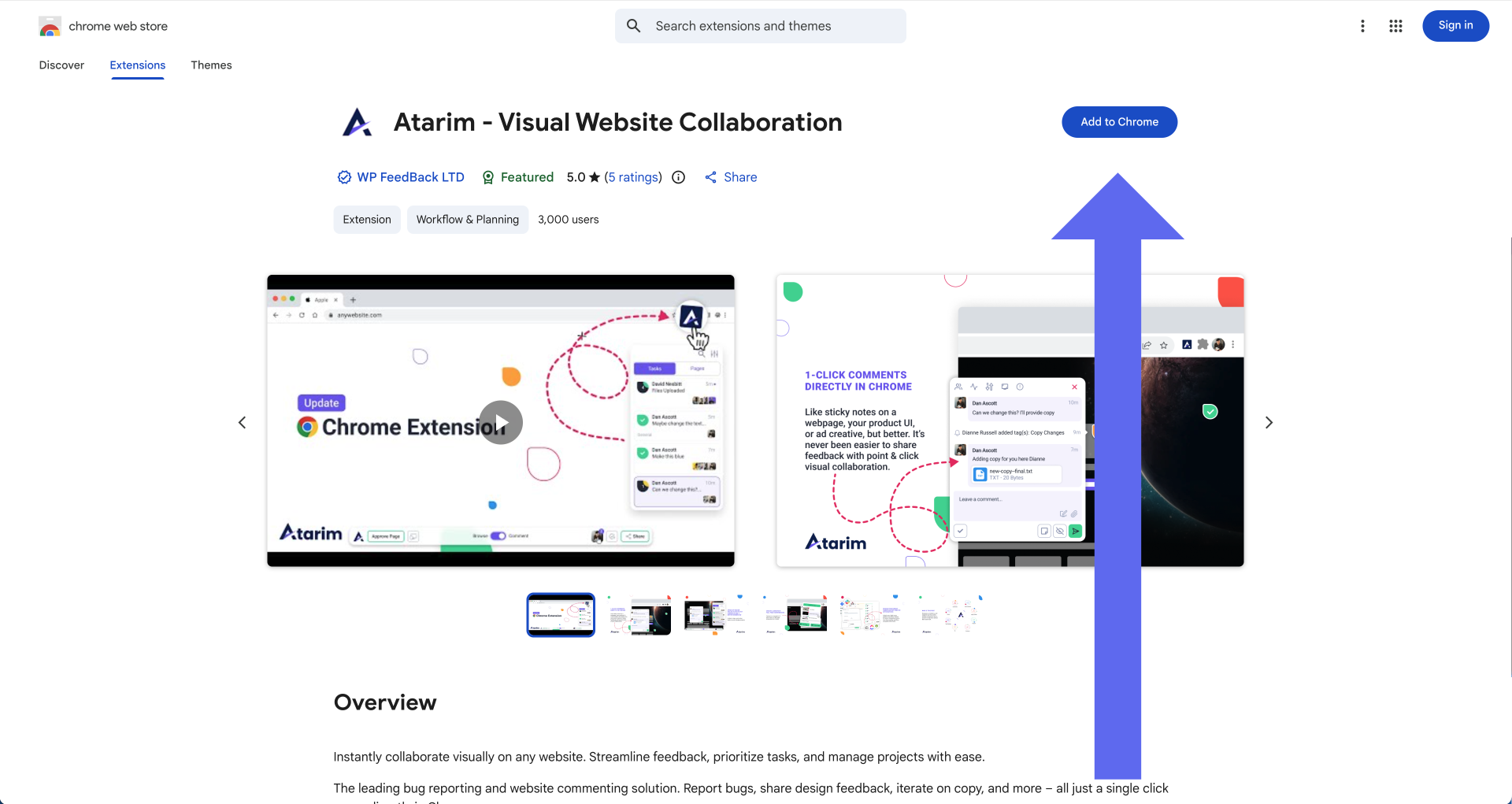
🌐 Our Updated Chrome Extension is Here!

Our Chrome extension saw an update last week that radically transforms the performance and stability of the Atarim. Go and install it right now. No, seriously, click THIS link and go into the web store to get it immediately.

Why is the Chrome extension such a big deal? Instead of reproducing pages inside the Atarim platform (as-was with the URL method you’ll be familiar with…) you can connect Atarim directly to your browser:

  • The InnerCircle (and Atarim as a whole) sees what you see
  • Screenshots are more accurate and faster
  • You can use Atarim on any page, on any site, at any time – including behind passwords, login screens and more. 

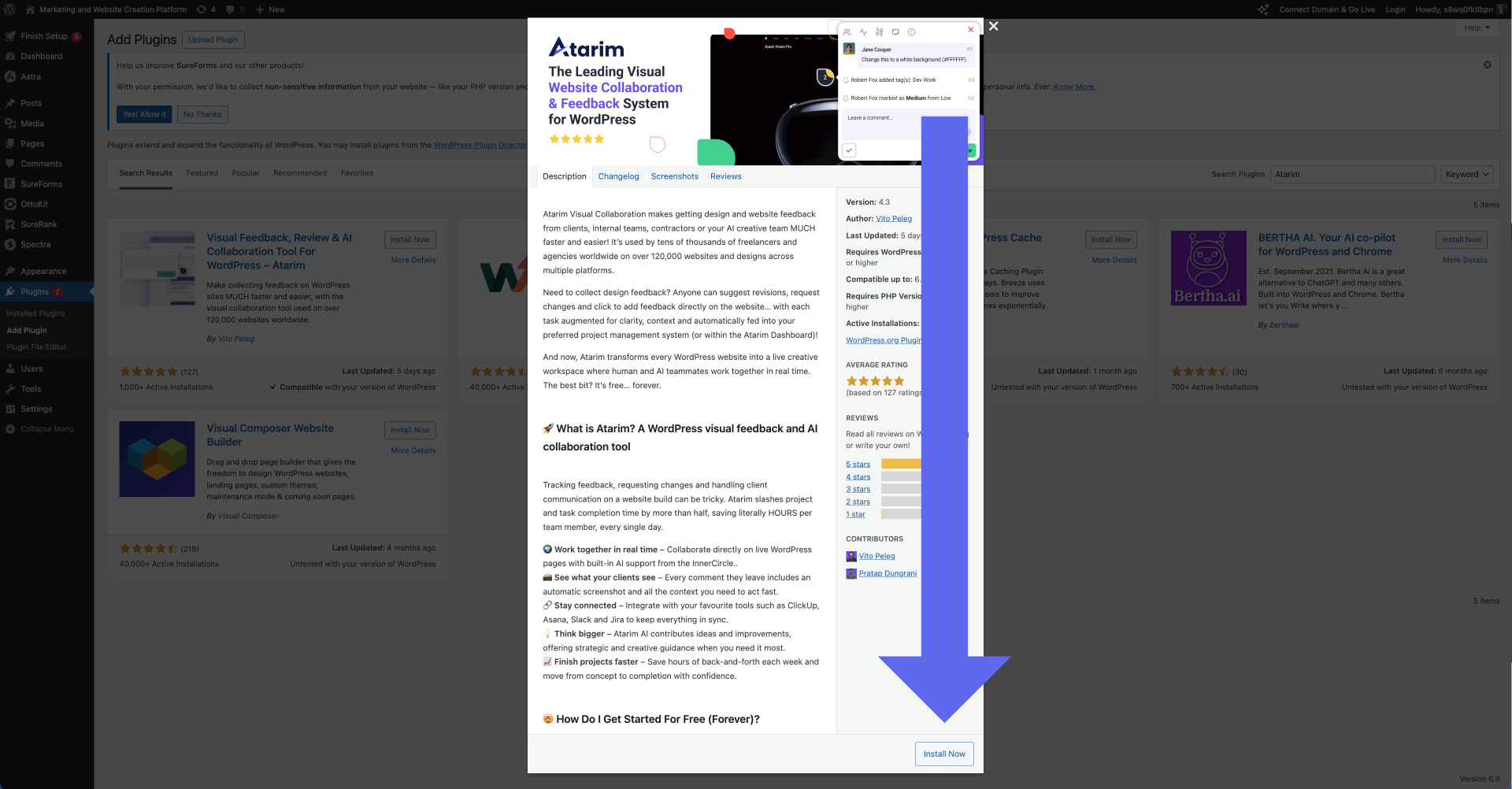
📝 WordPress Users Rejoice! The Plugin Has Been REBUILT

Atarim started life as a WordPress plugin, and today, we’re going back to our roots with a complete, ground-up rebuild in ReactJS.

This isn’t just a lick of paint; it’s a total architectural overhaul that brings the full power of the Atarim platform directly into your WP Admin.

Why bother with the plugin? Because native is better. By running Atarim inside WordPress, you’re unlocking:

  • Total Access: Finally leave feedback on gated pages, staging environments, WooCommerce checkout flows, and member dashboards.
  • Zero Friction: Use the ?collab=true magic to jump straight into a session without even touching a dashboard.

  • InnerCircle AI Integration: Your AI teammates now live inside your WordPress site, providing expert-level design and copy feedback exactly where the work is happening.

If you’re building on WordPress, this is the definitive way to use Atarim. Full stop.

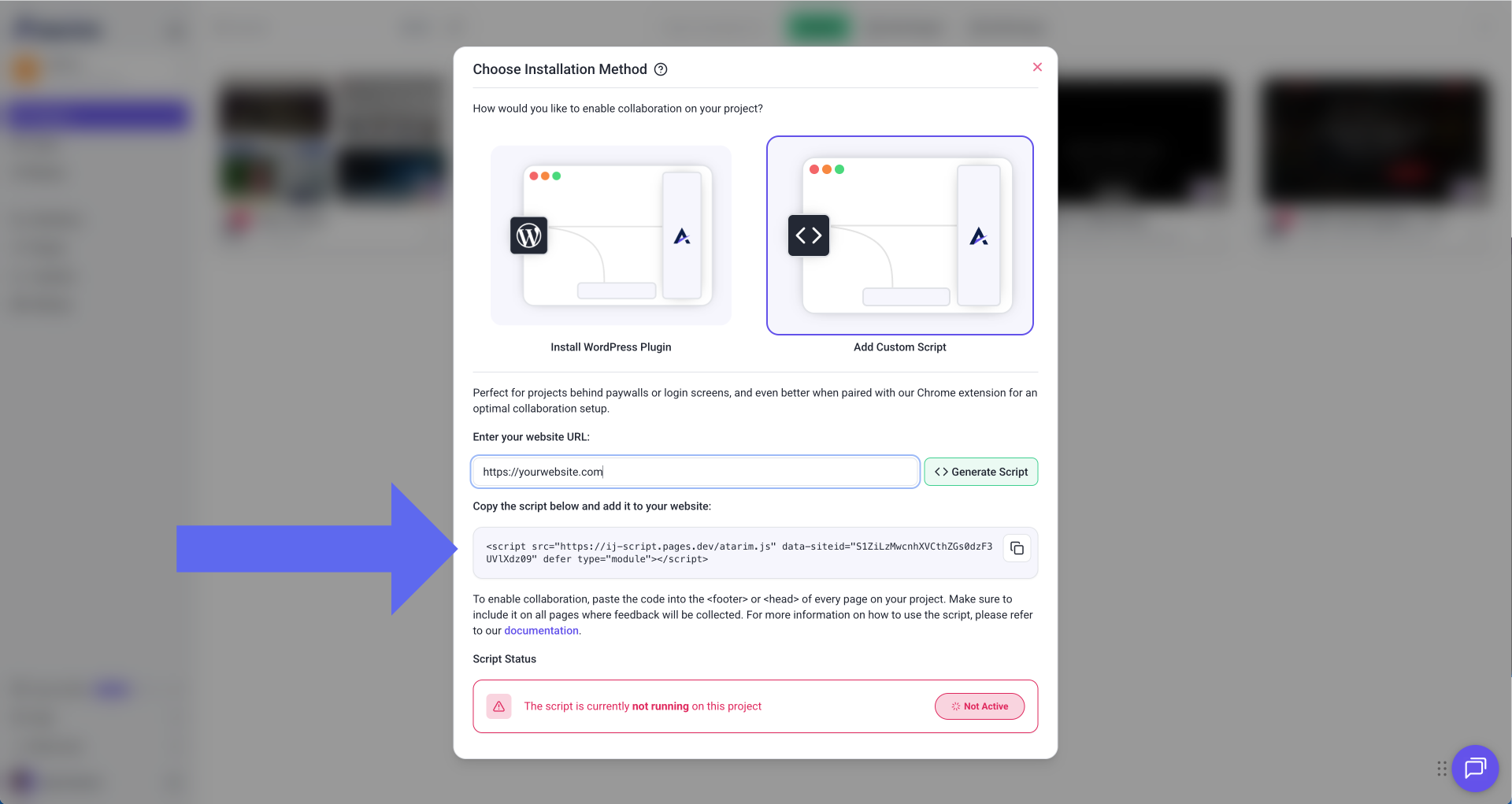
✂️ Web Snippet Overhaul: Install Atarim Natively Anywhere

Not on WordPress? Weird… Don’t worry, we won’t hold it against you. 

We’ve rolled out a massive update to our Web Snippet: a lightweight script that lets you embed Atarim natively onto any site, whether it’s Shopify, Webflow, or a custom-coded SaaS masterpiece.

The old “URL-proxy” method was great for a quick look, but the Snippet is where the real power lies:

  • Pixel-Perfect Accuracy: Because the script runs on the site itself, screenshots and annotations are more accurate than ever.
  • Smarter AI Agents: By giving our InnerCircle agents (Pixel, Lexi, and the gang) a direct view of your code and site structure, their feedback becomes exponentially more helpful.
  • The “Client-Proof” Experience: Your clients don’t need to install a thing. Once the snippet is in your footer, they just click and comment.

It takes about 60 seconds to install, but it’ll save you hours of “which page are you looking at?” emails every single week. Go do it NOW friend.

Which version should you use?

To make sure you’re using the right tool for the job, here’s the quick cheat sheet:

  • If you’re reading this: You know what’s up. Get the Chrome Extension to review any page on the web instantly.
  • For your WordPress sites: Grab the WordPress Plugin for the deepest integration possible.
  • For everything else (Shopify, Webflow, SaaS): Use the Web Snippet to give your clients a native feedback experience.

🤔 Comment Reactions!

One of our most requested features is hot and FRESH out of the kitchen. I’d suggest letting it cool down, but this is software we’re talking about so the risk of burning yourself is sufficiently low.

  • Add your choice of 5 reactions to any comment (Note: Dave, you’re allowed to use the happy one when reviewing my designs. It works, i’ve tested it. It hurts my feelings when you only use the angry one).
  • SECRET PURPOSE: We’re actually using this to track how you feel about our AI comments too. Is Pixel getting to you? Want to show Claro some love? We implore you to.